“The two main issues that weaken the historicity of the St. Thomas story and thus make St. Thomas a controversial figure in the modern day, is the reliance on the Acts of Thomas, as a pseudo-historical document, as well as the flimsiness of oral tradition as an accurate recording of history. Additionally, while the various arguments regarding the preservation of early Christian communities along the Malabar Coast are far more historically viable, they also cast some doubt over the validity of the St. Thomas tradition. It seems far more logical that Christianity was introduced to India by way of the Eastern Syrian Church, maybe as early as the fourth century CE, and maintained by subsequent migrations from those regions of the Middle East that fell under the jurisdiction of the Eastern Syrian Church.” – Thomas Charles Nagy
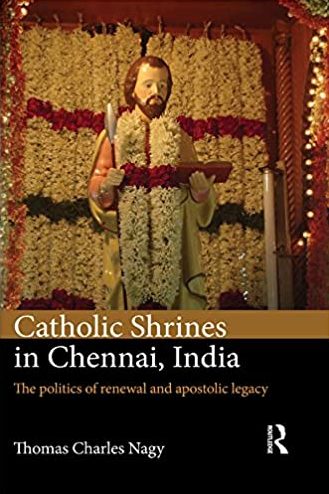
Abstract by Thomas Charles Nagy
This thesis investigates the phenomenon of Catholic renewal in India by focusing on various Roman Catholic churches and shrines located in Chennai, a large city in South India where activities concerning saintal revival and shrinal development have taken place in the recent past. The thesis tracks the changing local significance of St. Thomas the Apostle, who according to local legend, was martyred and buried in Chennai. In particular, it details the efforts of the Church hierarchy in Chennai to bring about a revival of devotion to St. Thomas. In doing this, it covers a wide range of issues pertinent to the study of contemporary Indian Christianity, such as Indian Catholic identity, Indian Christian indigeneity and Hindu nationalism, as well as the marketing of St. Thomas and Catholicism within South India. The thesis argues that the Roman Catholic renewal and “revival” of St. Thomas in Chennai is largely a Church-driven hierarchical movement that was specifically initiated for the purpose of Catholic evangelization and missionization in India. Furthermore, it is clear that the local Church‘s strategy of shrinal development and marketing encompasses Catholic parishes and shrines throughout Chennai‘s metropolitan area, and thus, is not just limited to those sites associated with St. Thomas‘s Apostolic legacy.
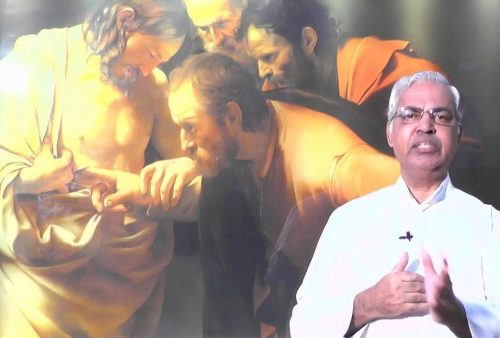
Observation by Ishwar Sharan
Readers of Thomas Charles Nagy’s thesis Catholic Shrines in Chennai, India: The Politics of Renewal and Apostolic Legacy, should be aware that the statements made to Nagy by the then parish priest of San Thome Cathedral Basilica, Fr. Lawrence Raj, are self-serving and, when referencing Ishwar Sharan, blatantly untrue.
Ishwar Sharan did not at any time attempt to contact Fr. Lawrence Raj, the Madras-Mylapore Archbishop, or the Kapaleeswar Temple Executive Officer by letter or any other means. Nor has Ishwar Sharan ever given a public lecture, appeared in a video, attended “live speaking events” or “written the temple in protest of the plaques”. Nagy has been deceived by Fr. Lawrence, and the priest has been grossly deceitful in order to bolster his public image of a zealous and faithful, even martyred servant of the Roman Catholic Church.
Thomas Charles Nagy did not attempt to get any Hindu perspective on the St. Thomas in India legend or the replacement of the original Kapaleeswara Temple by a St. Thomas Church (except to reference a few paragraphs of Ishwar Sharan’s book). Nor, unfortunately, did he verify any of the “candid” statements made to him by “big man” Lawrence Raj before publishing them.
Fr. Lawrence’s misrepresentations of Ishwar Sharan and Thomas Nagy’s credulity only prove Ishwar Sharan’s point, that St.-Thomas-in-India apologists are addicted to rumour and hearsay, adept at hiding the historical record by pretending that it doesn’t exist, and presenting themselves as martyrs for the Syro-Catholic cause of the anti-Hindu St.-Thomas-in-India fable.
Lastly, there is a ceratin irony in the fact that Thomas Nagy has came to the same conclusion that Ishwar Sharan did before him, that it is very unlikely that there were any Christians in India prior to the 4th century CE.
› Nagy’s comments on Sita Ram Goel and Ishwar Sharan can be found in the thesis starting at Chapter Three (3.3).
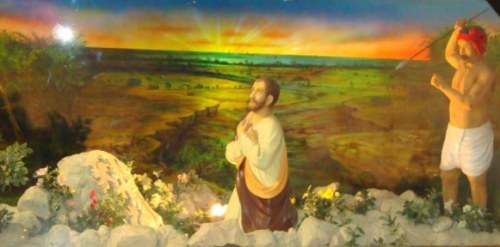
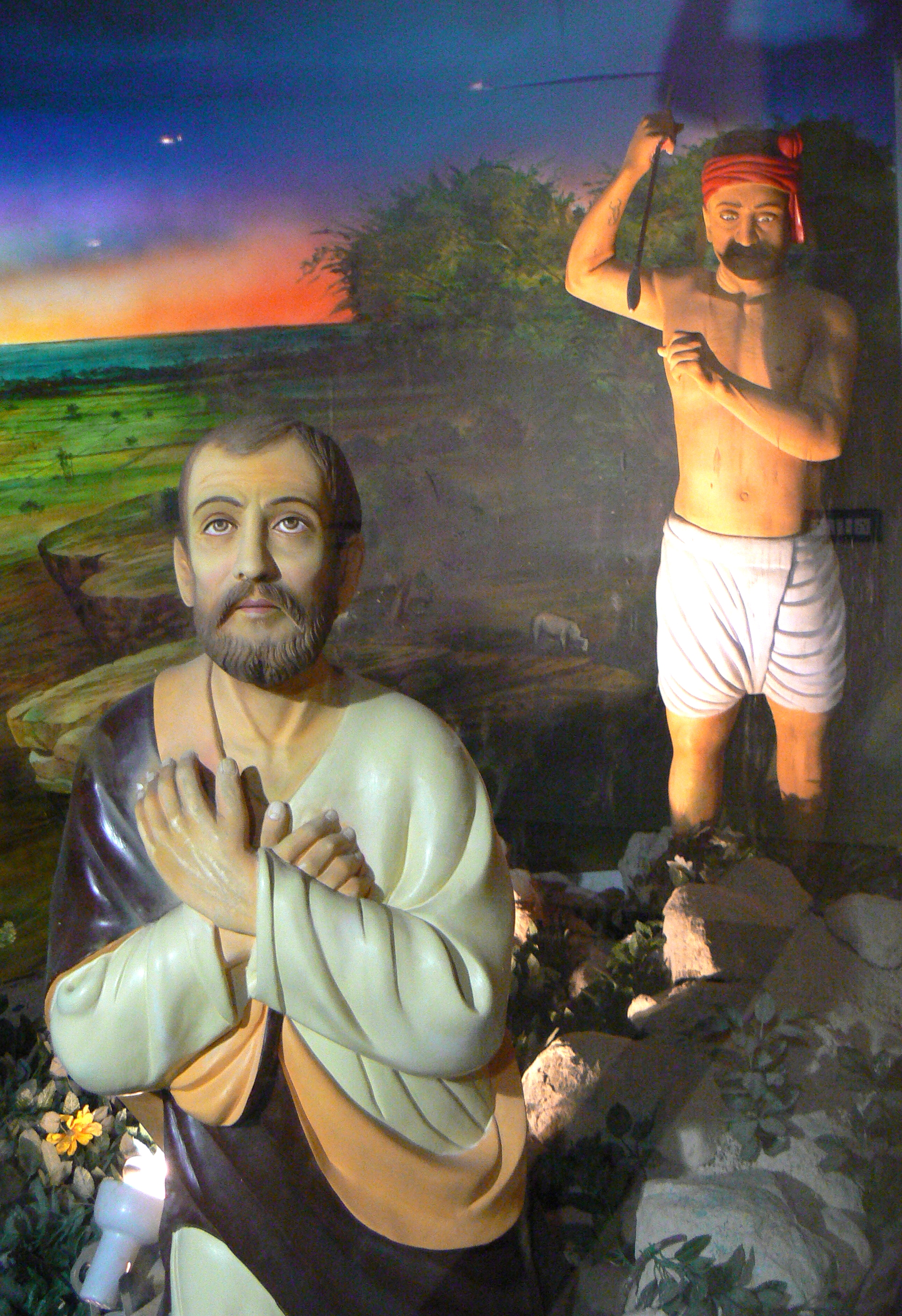
St. Thomas and his Hindu assassin as displayed in San Thome Cathedral Baslica. Contrary to Fr. Lawrence’s claim that the assassin is not a brahmin, only a brahmin would wear an antariya tied in the between-the-legs fashion depicted in the diorama. A non-brahmin in 1st century Mylapore would be wearing a veshti, a wrap-around-cloth that is not tied between the legs.
See also
- For an analysis of Nagy’s thesis see the Thomas Myth Blog.
- San Thome Cathedral cover-up uncovered – G.P. Srinivasan
- How Christians created their persecution mythology – Candida Moss
- The Haaretz Paradox: Why would an Israeli newspaper propagate the myth that St. Thomas was killed by Hindu priests? – Aravindan Neelakandan
- History of Hindu-Christian Encounters: AD 304 to 1996 – Sita Ram Goel






 ACTA INDICA
One response to “Catholic Shrines in Chennai – Thomas Charles Nagy”